The singularity is here, it’s just not evenly distributed yet. Long views on AI, Part 4

“How can AI work to shape a future worth living around the world?”
A 2025 – 2026 review through the lens of Knowledge Management, Graphs, Communities, Ontology, Connected Thinking and Pragmatic AI.
When OpenAI CEO Sam Altman admitted we’re in an AI bubble in August 2025, I wasn’t surprised. I’d been watching the cracks form for months from my seat running graph technology events, teaching AI courses, and consulting on knowledge management across Europe and beyond.
Some people call the process of creating, curating, sharing, using, and managing knowledge across an organization and even across industries knowledge management. I call it Orchestrating Things, and it’s my vantage point for positioning and reflection based on my work as an Analyst, Consultant, Engineer, Founder, Researcher, and Writer.
Stories from the trenches, reports more or less exaggerated, and future scenarios on fully automated luxury communism and semi-automated AI-driven capitalism.
This post is part of the “Long views on AI” series, exploring important questions on all things AI. We start from a question or statement and explore its background and implications, aiming to facilitate reflection and dialogue.
Table of Contents
- Managing Knowledge: The AI Industry’s Blind Spot
- Connecting Data, People, Ideas, and Graphs
- Connected Thinking, Connected Worlds
- Building Foundations and Pragmatic AI
- Join the Orchestrate all the Things Newsletter
- The Year of the Ontology
- AI-Driven Capitalism
- Peer to Peer AI in a Multi-polar World
- The Singularity: From Software to the World
- Intelligence, Latent Space, and Free Lunches
- AI and the Future: Where To, and What For?
Managing Knowledge: The AI Industry’s Blind Spot
Knowledge management has always been more art than science. The technology is rarely the bottleneck. The real challenges are buy-in, mandate clarity, governance, and shared vision. Getting people to agree on vocabularies, processes, what knowledge matters, and who’s responsible for what.
In 2025, working with organizations like GIZ (the German Agency for International Cooperation), I saw these same patterns everywhere. GIZ’s mission statement is “work to shape a future worth living around the world”. Following up on GIZ’s Pragmatic AI training, foundation work is needed to make AI work. The world is starting to see this too.
The AI industry spent years believing you could scale around these human problems. Just add more compute, more data, more parameters. But as the scaling paradigm hits its limits, companies are rediscovering structured knowledge: ontologies, knowledge graphs, metadata frameworks. The unglamorous foundation work that never went away.
Everything that follows – the graph technologies, the ontology renaissance, the Peer-to-Peer AI and Connected Thinking movement – stems from this realization. Knowledge management isn’t a boring enterprise discipline. It’s the foundation for sense-making, and the lens for understanding where AI goes next.
Connecting Data, People, Ideas, and Graphs
Knowledge curation is a key part of my work. It enables me to stay on top of things, it’s a bridge for building connections, content marketing currency, and a business or two in its own right.
First, Connected Data London – the event for those who use the relationships, meaning and context in data to achieve great things. Following a 2024 comeback, 2025 was the best CDL ever. In 2024 I shared how curation and creation work to make CDL24 a success.
In 2025, people were so generous sharing their CDL experience, there was little to add except documenting milestones. 10 years of connecting data, people and ideas, 12K leaders and innovators. It’s more than our tagline – it’s what we do, how and why we do it.

10 years of connecting data, people and ideas
The Year of the Graph hub is now a business of its own too. CDL and the YotG both focus on all things Knowledge Graphs, Graph Databases, Graph Analytics, Graph Data Science and AI, and Semantic Tech. 2025 brought ~75% audience and engagement growth for YotG, and a new content-driven business model bringing value to all sides.
None of this would be possible without the surge of interest in graph technologies and knowledge-based approaches. This, and the connections that came through CDL, led to another graph-oriented initiative.
An analyst, a practitioner, and a designer with over 40 years of combined experience in graphs join forces to bring the State of the Graph to life. A comprehensive, up-to-date repository, visualization, and analysis of the entire graph technology landscape. There’s a lot of work going into this, and we’ve started publishing results already.
Connected Thinking, Connected Worlds
Admittedly, graph parlance can sound pretty esoteric. But let’s pause for a moment and consider these quotes. “Here, everyone talks to everyone else”. “This is not just people who go to an event – this is a community”. The former by a CDL attendee, the latter by a CDL partner.
In 2025, thanks to our CDL partners, I had the opportunity to experience CDL as a member of the community myself. Getting to know and spend time with people and the opportunity to talk about more than graphs and technology was invaluable.
The experience made me reaffirm that people in this community really see connections everywhere, and seek knowledge as the foundation for their actions. It also made me appreciate how thoughtful and kind they can be. This contributed to framing what we now call Connected Thinking.
Connected Thinking, Connected Worlds
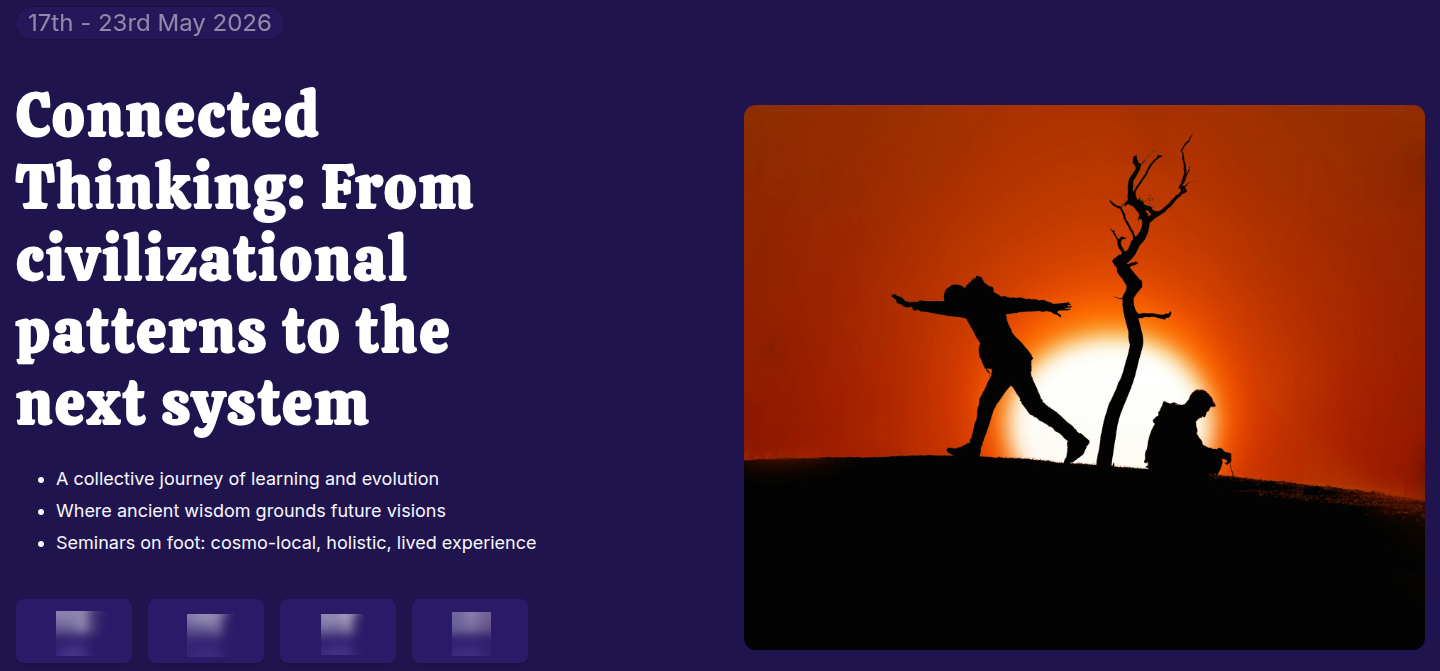
Connected Thinking is a unique journey of exploration, research, companionship, and grounding. It’s an event we are co-organizing with Michel Bauwens in May 2026. Wikipedia describes Bauwens as a “Belgian political theorist, writer, and conference speaker on the subjects of technology, culture and business innovation”.
Michel is a polymath, whose work on Peer to Peer and the Commons has been a reference for my research and thinking. A dear friend, with whom we’ve been talking about collaborating for a while. Michel has been grounding his work on Macro-history patterns towards a Fourth Generation Civilization. This is an attempt to connect our worlds.
Building Foundations and Pragmatic AI
In May 2026, Connected Thinking will be delivered back-to-back with Pragmatic AI Training, on-site at Lake Kaiafas in Greece. Pragmatic AI is an AI course designed for people who want to learn and use AI based on first principles without being data scientists. In 2025, I delivered Pragmatic AI both in-person and online. Teaching taught me a thing or two.
First – every cohort is a community too. There’s loads of work, and value, in putting together a curriculum and delivering lectures. Selecting topics, sources, structure, examples, visualization, sequence, pace, and style. Making hard choices, keeping the material up to date, and delivering it in an easy to follow and engaging way.
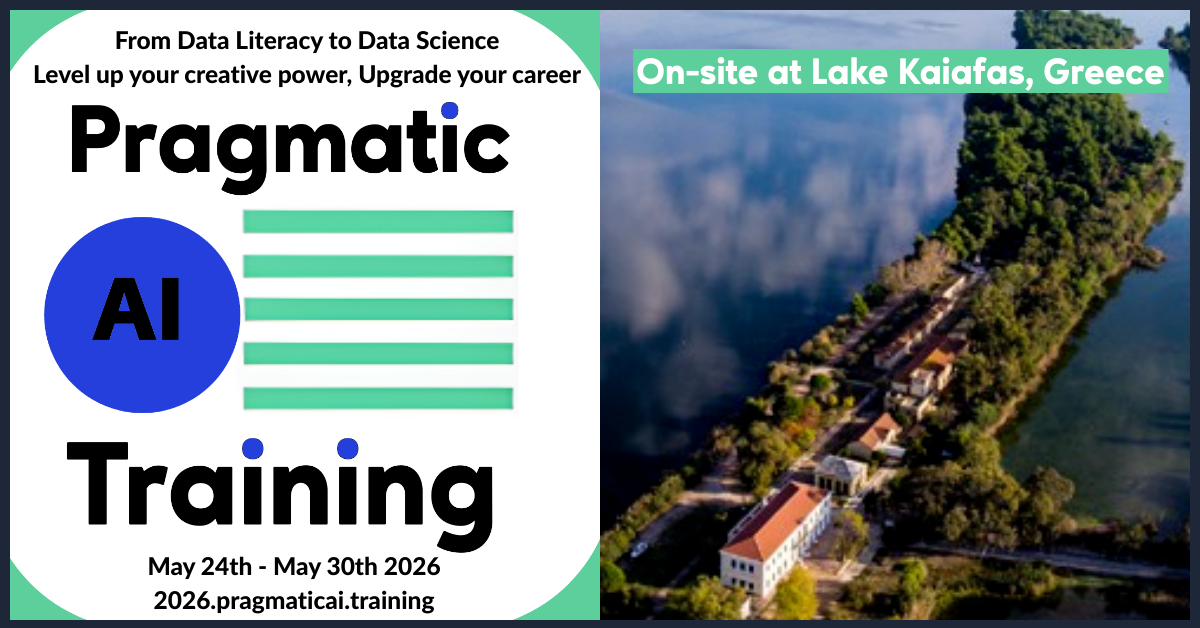
Pragmatic AI shows how to use AI based on first principles if you’re not a data scientist
But the hardest and most rewarding part is working with people live, not just putting everything on a one-size-fits-all platform. Engaging, explaining, empathizing, and learning from people. By the end of the course, relationships have formed and a community has emerged out of the shared experience.
Second – perseverance and grounding win in the end. The first few times I delivered Pragmatic AI, I had to explain why it’s important to include topics such as Knowledge Management, Metadata, Data Governance, Knowledge Graphs, and Ontologies. Today, it’s becoming clear that these are solid foundations for machine learning and GenAI.
Join the Orchestrate all the Things Newsletter
Stories about how Technology, Data, AI and Media flow into each other shaping our lives.
Analysis, Essays, Interviews and News. Mid-to-long form, 1-3 times per month.
The Year of the Ontology
2026 has been proclaimed the Year of the Ontology. Great – but what is an ontology, you may ask. An ontology is a formal, explicit specification of a shared conceptualization. Translation: an ontology is an agreement about what things exist in a particular domain, how they relate to each other, and what we call them.
Ontologies provide the semantic foundation that connects people, processes, and data into unified knowledge structures giving both humans and AI the context they need to reason, understand, and act with confidence. Ontologies are not new. But GenAI made the world rediscover them – to the extent it has.
Here’s why this matters today: As LLMs hit scaling limits, companies are discovering that structured knowledge – ontologies and knowledge graphs – solve problems that throwing more compute at never will.
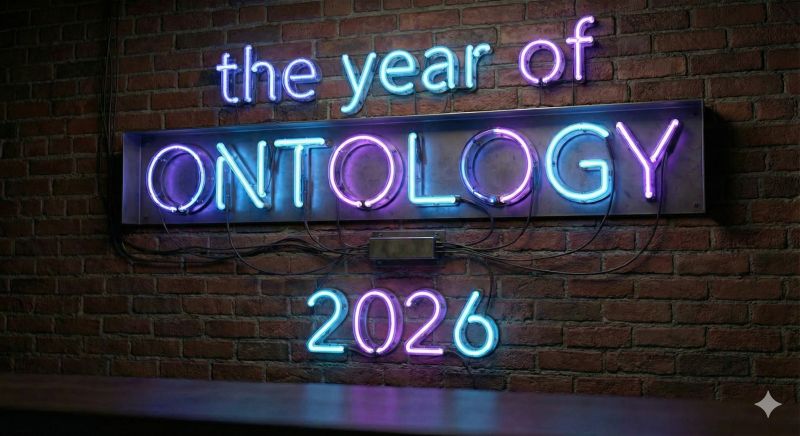
Will 2026 be the Year of the Ontology?
Using Google Trends and ChatGPT as proxies for the world at large, it looks like the up-and-coming references for ontology in 2026 are philosophy, the eponymous crypto coin, and Palantir. And if you talk to people working with data, AI, or enterprise architecture and ask, “what is an ontology?”, you’ll get different answers.
For some, ontology is a kind of clever data schema. For others, it’s a business glossary. For others still, the heart of a knowledge graph. Different communities adopted “ontology” and bent it slightly towards their own needs, resulting in confusion.
The fact that Microsoft and Palantir are adopting “ontology” too for their purposes adds to the confusion, but it also shows the dynamic. Seeing Bill Inmon, credited as the creator of the Data Warehouse, co-publishing on ontology is another sign.
The Ontology issue of the Year of the Graph is on course to be the most popular issue ever. And for the first time, there is a market report on ontology and more than one on the Semantic Web.
What all of that suggests is that we’ve been onto something – pun intended. Introducing and showcasing ontology for the Pragmatic AI Training and releasing the Connected Data Knowledge Graph were among my 2025 highlights. Reception is pointing towards more ontology work in 2026.
AI-Driven Capitalism
There are two things that permeate through almost everything I do: the Pragmatic AI Training, and the Orchestrate all the Things podcast and newsletter. Pragmatic AI cuts through the hype to teach how things work. Orchestrate all the Things engages with thought leaders and builders. The two inform and complement each other.
Knowing how things work enables engaging with topics and people on a different level. And what I learn from people shapes my perspective and finds its way back into project and education work. Here’s how all of that shaped the key themes I see playing out from 2025 to 2026.
The “LLM scale is all you need” mantra and the narrative that AGI is coming are ending. Some of us never believed it, and were just waiting for the noise to subside. Now, people like “AI godfather” Yann LeCun, OpenAI Co-Founder Ilya Sutskever and Richard Sutton of “Bitter Lesson” fame are articulating that LLMs are not the way.
When the LLM-powered AI bubble breaks, things will get ugly
For most of the world except AI geeks, that would not really matter that much. Just another swing of the AI pendulum that’s been swinging since “AI” was coined. Except that now there’s a whole lot of money and power invested in the AI narrative, and we’re officially in the AI-driven capitalism era.
“OpenAI took the papers from Google out of the dumpster and Microsoft gave the money to supercharge it. Microsoft threw the money in and said, we are going to have a new growth narrative. [..] The narrative went from this is the future to actually, this is a very expensive future. You need to be able to afford nuclear power plants and have your own data centers. So only us can do it”, as Georg Zoeller put it.
When we talked about the bursting of the AI bubble early in the summer of 2025, this was still heterodoxy – even though 2025 kicked off with DeepSeek. Then OpenAI CEO Sam Altman admitted that we are in an AI bubble, and AGI is losing relevance. But AI’s trillion dollar deal wheel kept bubbling around Nvidia and OpenAI. More and more people realize that when the AI bubble bursts, things will get ugly.
Peer to Peer AI in a Multi-polar World
The shift towards towards a different, more robust AI that Gary Marcus outlined in 2020 is possible. The impact that ontologies and knowledge graphs are having as the essential truth layer for Pragmatic AI is a sign of that. This is important beyond conflicting world views and models.
AI not premised on mega-models that need mega-factories to train and operate could be part of Peer to Peer AI. “The real choice isn’t between winning or losing an arms race – it’s about whether we want an AI created by humanity for humanity, or an AI shaped by the cycles of conflict and domination that we need to move beyond”, as Arnaud Bertrand put it.

Are we entering the era of Peer to Peer AI?
AI is being commoditized as open source models, notably Chinese ones such as DeepSeek, Qwen and Kimi, are not just catching up but increasingly leading. This means , as Tony Seale noted, that “organizations need to take the power they’ve got in the models that they have in their hands right now, and focus that back upon the data they have”.
This brings us to another point, one that transcends AI and technology: the rise of China in a multi-polar world. It doesn’t look like efforts to hamper China’s progress in AI by measures such as restricting access to advanced AI chips are working. If anything, this may be fueling innovation and the establishment of an independent ecosystem.
A number of reports from different sources, including US auto industry executives, are making it clear that China is taking the lead not just in AI, but also in domains such as renewable energy. The response seems to be what was called the Bunker State doctrine. Extrapolating from AI may offer some insights on its prospects.
The Singularity: From Software to the World
AI that runs locally and leverages domain knowledge can be better/faster/cheaper than “LLM-everything” approaches. This also applies to the domain AI is transforming faster than anything. In software engineering, even people as experienced and talented as OpenAI founding member Andrej Karpathy are feeling left behind.
What this means is that the machine is beyond control at this point. Zoeller thinks this is intentional, and calls it a singularity. Intentional or not, so far this is mostly constrained in software engineering, and results are mixed. Software engineers can ship code faster. But shipping code was never the bottleneck.
What about the most important parts in the lifecycle of software – reading, understanding, architecting and maintaining code? What about learning through the process – a substantial part of the evolution of software engineers? What if/when AI is used to build more AI? What if/when this expands beyond software engineering?
We’ll be addressing these questions in the next issues of Orchestrate all the Things. As for the last part, we’re all about to find out as Claude Code is now opening up to non-coders. Claude Code is arguably the most successful AI application, transforming how software engineers work.
When Anthropic released Claude Code, they expected developers to use it for coding. They did, and quickly began using it for almost everything else. Non-developers started using it too – for example, for legal work and MBA “vibefounding”. This prompted Anthropic to build Cowork: a simpler way for anyone to work with Claude in the same way.
Intelligence, Latent Space, and Free Lunches
Ethan Mollick’s MBA “vibefounding”insights on how people can get 10X more productive with AI ring true. I’ve experienced this using LLM assistance to solve technical problems outside of my domain of expertise as well as to brainstorm and elicit feedback.
Being able to pinpoint and describe the issue at hand, and then critically evaluate and apply LLM input can make the difference between being stuck and breezing through, as well as provide new perspectives. I don’t ascribe any kind of intelligence or agency to LLMs – it’s all latent space. But it works.
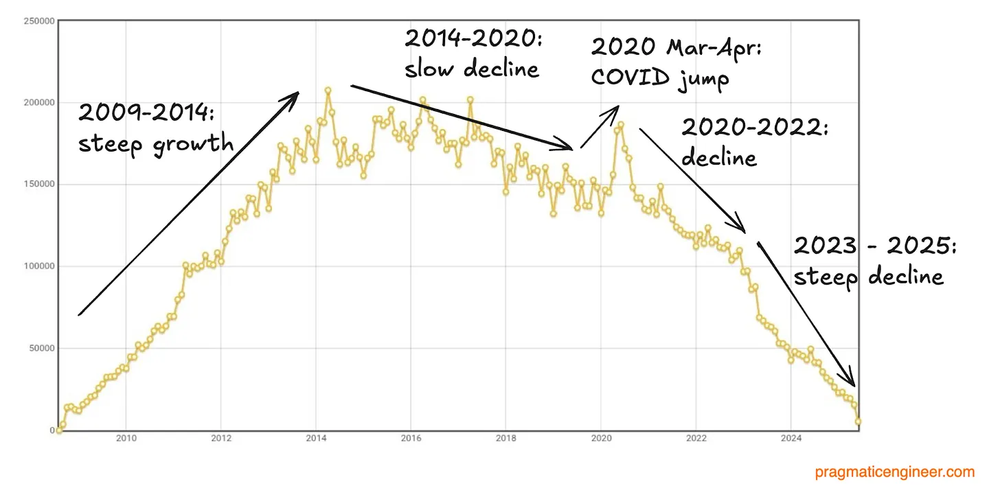
The success of LLMs hinges on vacuuming data from places such as Stack Overflow
Still, there’s no such thing as a free lunch. The success of LLMs hinges on vacuuming swathes of data from places such as Stack Overflow and Tailwind that suffer the consequences. And AI “creativity” hinges on vacuuming copyrighted work, which can then be reproduced.
Of course, there’s nuance here. Whatever worldview each of us subscribes to, it’s limited by our bias and partial, distorted lenses – the world is more complex than most of us think, and AI is no exception.
The demise of places like Stack Overflow and Tailwind may not be exclusively due to AI. Traffic is down, but alternative business models are keeping businesses alive. Some creators are being compensated for the use of their work, while research found that text-to-image AI enhanced creative productivity by 25% and the art’s value by 50%.
AI and the Future: Where To, and What For?
Could this be a peek into a future where everyone is fitter, happier, more productive with AI – fully automated luxury communism? Or are we headed towards multiple AI-induced or accelerated crises (institutional, environmental, and mental health) – semi-automated AI-driven capitalism? Is AI an economic singularity or a normal technology?
The question isn’t whether AI will transform everything – it’s already doing that. The most important question is, as always – what for? How do we imagine futures we’d want to live in, and what do we do to bring them to life?
The question is whether we’ll build AI as a commons, grounded in shared knowledge structures and peer-to-peer principles, or surrender to a future where AI is a form of non-kinetic warfare.
The work we’re doing at Connected Data London, Pragmatic AI and Connected Thinking in 2026 is our way of contributing, building on principles and work as laid out by so many others before us. Will you join us?