Connected Thinking: On History, Technology, and the Art of Seeing What’s Coming

Why the seeds of the next civilization are already growing, and how to unveil them with Connected Thinking.
What if the chaos around us isn’t collapse, but transformation?
Michel Bauwens has spent decades mapping the edges of change. From peer-to-peer networks to the commons, from medieval guilds to distributed autonomous organizations, he’s been tracking something most people miss: the seeds of a new civilization, already growing underneath the noise.
Some people might call Bauwens a unicorn, because he does not fit neatly into any category. He has worked in corporations and the United States Information Agency. He ran startups, and co-produced a film. Then, in 2003, walked away from all of it to spend two years studying social change. That sabbatical never really ended.
Out of it came the Peer-to-Peer Foundation, which he established in 2005. Since then, he has advised city mayors, worked with the Vatican, and immersed himself in the macro-history of civilizations. Today he writes on his Substack, Fourth Generation Civilization, tracking the patterns underneath our current disruption.
Bauwens’ early work on peer-to-peer systems caught my attention back in the early 2000s. At the time, I was doing research on the intersection of distributed systems, knowledge representation and reasoning, and collective decision-making.
That thread has woven through two decades of parallel intellectual exploration, has been the foundation of a long-standing friendship, and has shaped a shared project called Connected Thinking.
Table of Contents
- Peer-to-Peer: More Than a Technology
- Understanding the Commons
- Cosmolocalism: When the Physical and Digital Converge
- Historical Roots: From Guilds to the Noosphere
- Civilizational Patterns: The Long View
- From the Roman Empire to Distributed Autonomous Organizations
- Connected Thinking
- Seeing the Butterfly
Peer-to-Peer: More Than a Technology
When most people in tech hear “peer-to-peer“, they think of a networking protocol. Bauwens notes that peer-to-peer is something far more consequential.
“If you allow computers to talk to each other without a centralized service,” Bauwens explains, “you also allow people to talk to each other without centralized intermediaries. And that creates a new capacity in the world for trans-local self-organizing.”
The key word is trans-local. For the first time in history, people in different places can see each other in real time, coordinate work, run organizations, and align around shared goals, without anyone in the middle giving orders or extracting a fee. That capacity, Bauwens argues, is genuinely new.
Open source software, free software licenses, open design, and cryptocurrency are all expressions of this same dynamic. They are the governance and property formats that this new mode of organizing requires. Underpinning all of them is a principle called stigmergy: the capacity to coordinate work through mutual signals rather than command.
Wikipedia and Linux work because contributors can see what is missing, and take the initiative to fill in the gaps. AI, Bauwens notes, is essentially stigmergy without the people: digital representations coordinating and producing without direct human intervention at every step.
Understanding the Commons
Few concepts are more misunderstood or more important than the commons. Most people encounter it through the “tragedy of the commons,” a story that has been largely debunked, but which still shapes the conversation.
Bauwens offers a cleaner definition by contrast. Private property means: it’s mine, and you need my permission or payment to use it. State property means: a collective resource that the state controls, not you and not your community. Commons resources are held and governed by the community itself, according to rules the community sets.
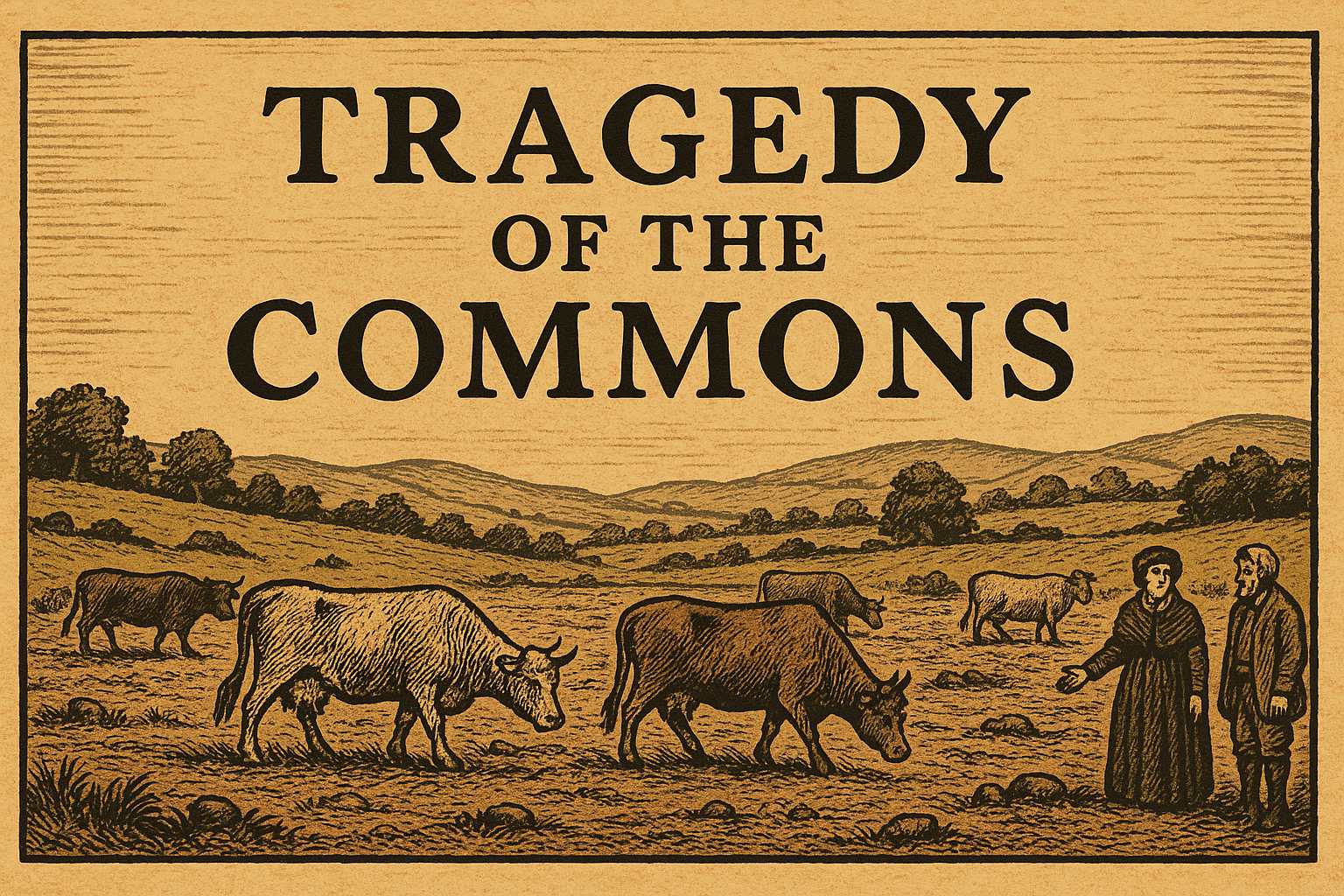
The “tragedy of the commons” is a false narrative, but it still shapes the conversation.
Three elements are essential. First, there is always a resource – something tangible or intangible that people share. Second, that resource is maintained, defended, and often created by a specific community of stakeholders. Third, the community governs it according to its own rules and norms, not external authority.
The history of the commons tracks the history of industrial capitalism. When enclosure movements privatized land, displaced workers moved to cities and mutualized something else: life risk. The result was the 19th-century explosion of unions, cooperatives, mutual aid societies, and housing cooperatives. These social commons eventually became the foundation of the welfare state.
Then came the digital revolution, and with it, a massive return of commoning: people learning together online, building shared encyclopedias, creating collaborative software protocols. The digital commons was born.
Cosmolocalism: When the Physical and Digital Converge
Once you have a functioning digital commons, something interesting happens. Companies that once competed now depend on a shared resource they jointly maintain – Linux is a good example. A new economic logic emerges: contribution rather than extraction, shared value rather than scarce goods.
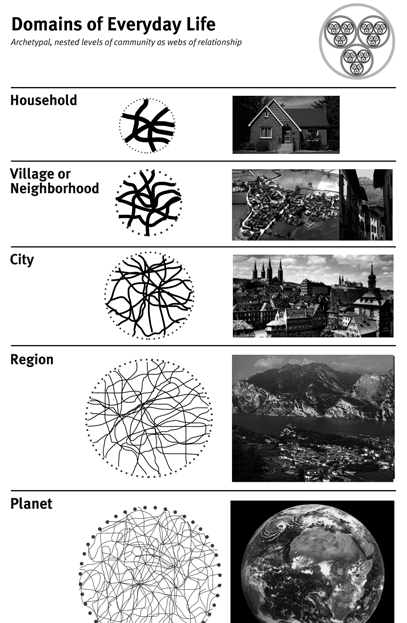
Bauwens calls the next stage cosmolocalism, and it is where the digital and physical worlds converge. The principle is elegant: what is heavy stays local; what can be shared, scales globally.
A housing cooperative uses digital commons to manage governance. An urban permaculture garden connects with similar projects worldwide, sharing knowledge and design innovations in real time. A small biotech firm joins a research commons with other small firms, enabling them to compete with multinationals.
“In an open ecosystem,” Bauwens explains, “any innovation anywhere is available to the whole network.” A new machine that works on mountainous terrain, developed in the Andes, can reach Tibetan highlands the same day.
This new paradigm also requires new forms of governance. Open source communities have what Bauwens calls a “reinvented hierarchy”: not flat, but fundamentally different from corporate command structures.
Maintainers don’t tell contributors what to do; they defend the integrity of the ecosystem. Contributors choose their own work. Licenses such as the GPL ensure that what is contributed to the commons stays in the commons.
The underlying shift is what Bauwens calls “a true value revolution”: from a commodity regime where you produce scarce goods and sell them at a price, to an open system where you contribute to a commons, and the market becomes derivative from that contributory value.
Historical Roots: From Guilds to the Noosphere
There are historical precedents for all of this; although the analogy is imperfect, it functions in an instructive way.
Medieval guilds were trans-local in their own fashion: craftsmen traveled between regions, carried knowledge across borders, and maintained standards across cities. But guilds were always collocated. Physical proximity was essential to the work. Today’s peer-to-peer communities are scattered across continents yet deeply coordinated. The shift is not merely one of geographic scale.
“It’s not just a bigger geography,” Bauwens says. “It’s actually another plane.” He borrows the concept of the noosphere – the sphere of shared human knowledge – to describe it. The digital commons has its own geography, its own territories, its own dynamics. It is not an extension of physical space; it is a new kind of space altogether.
Looking further back, Bauwens finds a more surprising historical parallel: religious communities. The Pope was never the head of a physical nation-state in the modern sense. He led all Catholic believers, wherever they lived. These were communities of affinity, not kinship or geography, organized around shared belief and common purpose.
Today’s digital communities organize around shared projects and joint aims. Bauwens calls it “object-oriented sociality”: what unites people is a common goal, not a common location.
Civilizational Patterns: The Long View
It was COVID that pushed Bauwens to take the long view even further. Confined, unable to travel, he did what he had done in 2003: he started reading. But this time without a fixed endpoint. Since 2020, he has systematically worked through the macro-historians – three distinct schools of civilizational analysis – building what he describes as a pattern library.
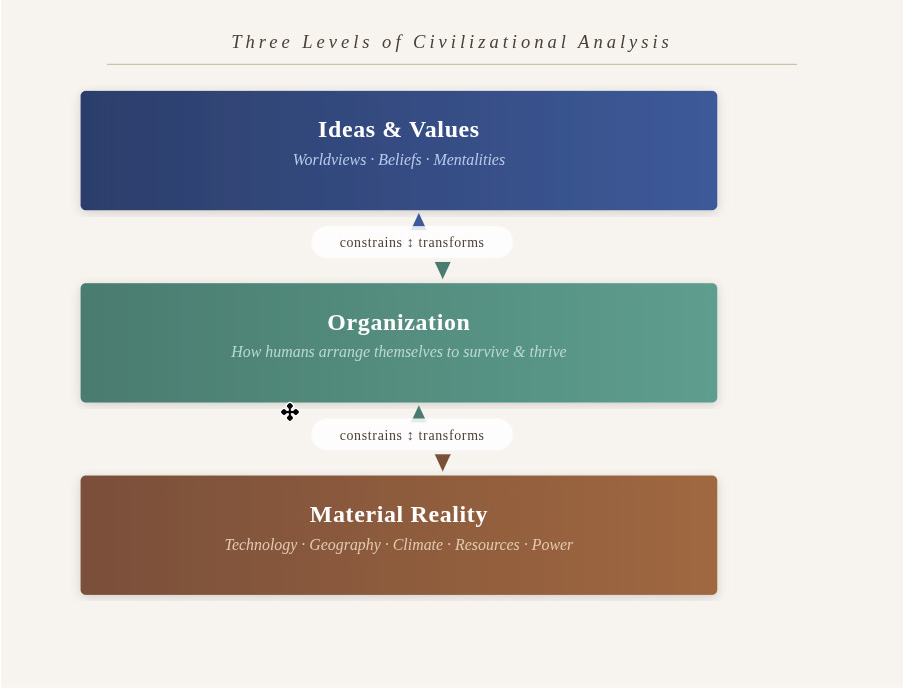
The framework Bauwens has developed operates at three levels.
At the base is material reality: technology, geography, climate, resources, military power.
Above it is the question of organization: how do humans arrange themselves to survive and thrive within a given material context?
And at the top are ideas and values: the worldviews, beliefs, and mentalities that help make sense of the world and that can, in turn, reshape it.
These three levels interact in both directions. Material conditions constrain what ideas are possible. Ideas can transform material conditions. The relationship is dialectical, not deterministic.
From the Roman Empire to Distributed Autonomous Organizations
To make this concrete, Bauwens returns to one of history’s great transitions.
The Roman Empire was built on conquest and slavery. Expansion was the engine; when expansion stopped, the engine stalled. Decline was not a moral failure – it was a structural one. As the empire contracted, a new value system was already taking root at the margins.
Christianity, in its early form, was a radical value revolution. Roman citizens believed work was for slaves; the free citizen’s calling was philosophy and civic life. The body, which slaves used for labor, was relatively unimportant. The mind was everything.
Christianity inverted this: work and prayer were equally sacred, matter and spirit of equal importance. Work became participation in a divine project of improving the world.
The point is not that one system was superior. It is that the transition was not an evolution from one version of the same thing to another – it was a bifurcation. The new system emerged from what had failed in the old, and it went in a completely different direction. Buddhism, Taoism, Confucianism, and Advaita Vedanta each represent similar ruptures in different civilizational contexts.
“We are in the middle of a similar, very deep transformation of our society,” Bauwens argues. “The old hasn’t died yet, and the new isn’t there yet.” Antonio Gramsci called this the time of monsters. But for Bauwens, it is also the time of seeds.
Seed forms such as DAOs (distributed autonomous organizations), universal currencies independent of state and market, and new accounting systems do exist. None of these are solutions on their own. But they are prefigurations: early forms of something that does not yet have a name.
Connected Thinking
This is the intellectual framework behind Connected Thinking. Connected Thinking is a unique journey of exploration, transformation, companionship, and grounding. A series of interactive seminars on foot, reviving the peripatetic school tradition of ancient thinkers in meta-modern times.
At its core, Connected Thinking is about asking deep questions in a context of genuine free inquiry. “Speech is policed in social media, filtered in the media, constrained in universities,” Bauwens observes. The value of being among free thinkers who can explore the full depth of what they know is not merely intellectual – it is transformative.
What do participants gain?
Pattern Recognition Skills. The ability to identify macro-historical patterns and distinguish between what is truly obsolete, what is currently working, and what is just beginning to emerge.
Strategic Clarity. When you understand the patterns underneath disruption, anxiety gives way to situational awareness. You stop reacting to surface noise and start seeing the structure beneath it.
Deep Historical Context. Access to a synthesis of lifelong macro-history research, with frameworks that extend from past to future and illuminate the civilizational transition we are currently living through.
Practical Agency. The ability to act on underlying patterns rather than surface trends. To understand the operating system of societal change, not just the application layer.
Seeing the Butterfly
Bauwens frames the psychological dimension with a striking image. If you live at the end stage of a civilization, everything is going down. It is very hard to sustain energy and hope.
But if you learn to see seed forms, if your eyes are trained to notice the new things sprouting at the edges, you see not decay but transformation. You see the caterpillar that does not yet know it carries the DNA of the butterfly.
The difference between being post-seasonal (clinging to approaches that no longer work), seasonal (able to play skillfully within the current moment), and pre-seasonal (working now on the seeds that will matter when conditions are ready) is not merely an analytical distinction. It is a practical one, and a deeply personal one.
“The more you can go to the past,” Bauwens says, “the more you can go to the future.” History, understood as pattern rather than chronicle, becomes a tapestry of added meaning: not applied mechanically, but carried as orientation.
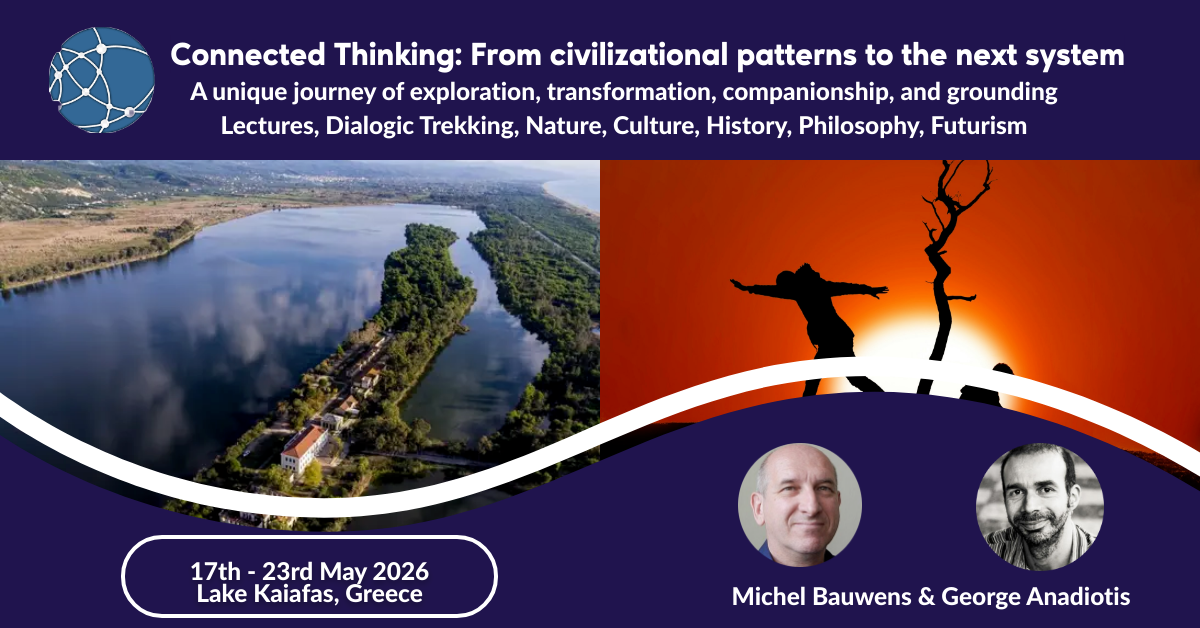
Connected Thinking is a collaborative project by Michel Bauwens and George Anadiotis. The immersive on-site program takes place at Lake Kaiafas, Greece, combining Michel’s macro-historical framework with George’s situational awareness in a peripatetic format: dialogue, lectures, and walks through sites of historical and natural significance.
Related posts:
 Open-source growth and venture capital investment: Data, databases, challenges, and opportunities
 Healthcare’s $3 trillion question: Should the likes of Google and Facebook control this data?
 Working from home means working different hours, but not necessarily more
 You.com raises $50M to lead AI for Knowledge Workers