Fair Patterns: Designing for Human Autonomy in the Age of AI

We live in a world fraught with interfaces designed to work against you. Most people sense it. Few can prove it, and fewer still are trying to fix it.
There is a particular kind of frustration that arrives when you understand a problem perfectly and cannot do a single useful thing about it. Marie Potel-Saville spent years living inside that frustration.
First as a competition lawyer cycling through antitrust litigation across Europe. Then as in-house counsel watching the law get treated as a cost center. She pivoted, trained in innovation by design, and launched her first company in 2018.
Potel-Saville was looking for the gap between what the law said and what the internet did to people. She found it immediately. The term was “dark patterns.” And her first instinct – the instinct of a lawyer and a builder – was to ask a question nobody in the field had thought to ask: what’s the antidote?
That question eventually became Fair Patterns, a multimodal AI platform that detects online manipulation and addictive design at scale. Fair Patterns went live in January 2026, and recently won the 2026 Digital StartUp award in cybersecurity and sovereignty. It is trying to redefine digital products and online experiences.
Table of Contents
- Dark Patterns Everywhere: What They Are, What the Law Says
- Dark Patterns and Landmark Verdicts
- 16 Taxonomies, Zero Cures: The Limits of Dark Pattern Research
- How Generative AI Is Making Dark Patterns Worse
- Fair Patterns: Designing for Human Autonomy
- Addictive Design vs. Dark Patterns
- How Fair Patterns Fixed Automated Dark Pattern Detection
- Fair Patterns in Practice: From HP’s Design to Strategic Litigation
- The Competition Law Argument
- A Movement, Not Just a Product
Dark Patterns Everywhere: What They Are, What the Law Says
Potel-Saville defines dark patterns in deliberately simple terms. A dark pattern, she says, is “an interface that makes you do something you wouldn’t have done if someone had asked you the question – if you had understood what’s going on.”
Simplicity is a deliberate response to the field’s complexity. Researchers, regulators, the FTC, the European Data Protection Board have all researched dark patterns. The level of scientific sophistication is impressive, but the problem keeps spreading. As Potel-Saville puts it, “you’re always running behind the reality.”
The everyday examples are familiar enough that most people have stopped noticing them: cookie banners architected to make rejection take three extra clicks; free trials that quietly convert to paid subscriptions with cancellation flows designed to exhaust you; geolocation requests framed so that refusing feels like you’re breaking something.
The legal landscape in Europe has been building toward explicit prohibition. GDPR and the Unfair Commercial Practices Directive apply to dark patterns through general principles. The Digital Services Act goes further, expressly prohibiting them in Article 25.
The Digital Markets Act has a dedicated anti-circumvention provision. The EU AI Act prohibits dark patterns in AI systems under Article 5. And the Digital Fairness Act – still in project stage, expected for proposal by mid-2026 – is intended to fill the remaining gaps, particularly around addictive design.
Dark Patterns and Landmark Verdicts
A European Commission study found that 97% of Europe’s most-visited websites contain at least one digital violation. The DSA allows fines of up to 6% of global turnover; competition authorities can go to 10%. Courts have started moving too, and that means the compliance math is shifting.
In March 2025, a Los Angeles jury found Meta and YouTube liable for designing addictive products targeting teenagers and children. The World Health Organization recognizes social media disorder as sharing the same damaging mechanism as substance addiction. What made the Meta verdict distinctive was the discovery process.
Internal documents revealed a deliberate strategy: the younger a child started using Instagram, the more addictive it became. One document put it bluntly: “If we want to win big in teens, we need to take them as tweens” – meaning children aged eight to eleven.
Epic Games settled with the FTC for $520 million over dark patterns in Fortnite. There are now numerous lawsuits filed in the US against major video game companies for intentionally designed addictive games that target children. The scale of the exposure, financial and reputational, is becoming concrete.
16 Taxonomies, Zero Cures: The Limits of Dark Pattern Research
“Quite ironically, the sophistication of the taxonomies and even the ontology doesn’t help to cure the problem. It’s intellectually very interesting. It makes for great scientific papers. But you’re still left with no practical solution and with a digital plague that keeps spreading as you develop the conceptual framework to understand what it is”, Potel-Saville said.
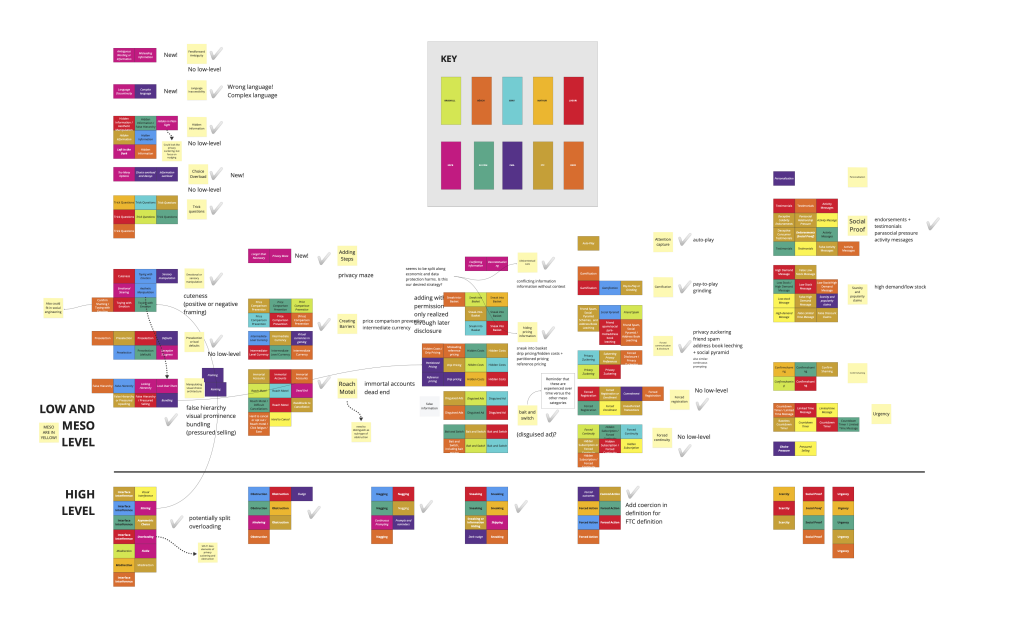
Dark patterns are well-researched and understood. What’s been missing is action to fight back.
This is a tension that will resonate with anyone who has worked on data models or ontologies in applied settings. There is an adage in the data modeling community: always start with the end goal in mind. What is the use case? Who are you serving? What questions need answering?
An ontology built without a concrete purpose – however rigorous – risks becoming an intellectual exercise that documents a problem without touching it. The Ontology of Dark Patterns Knowledge was created with a precise legal purpose: to counter the argument that “dark pattern” was too vague a concept to prohibit.
By encapsulating all the fragmented taxonomies into a unified formal structure, the ontology gave regulators and litigators a foundation to say: this category is real, defined, and actionable. The broader body of research, while meticulous on naming, root causes, and legal grounds, produced almost nothing on solutions.
How Generative AI Is Making Dark Patterns Worse
Harry Brignall, who coined the term “dark patterns,” told Potel-Saville honestly when she asked him about the antidote that he didn’t think the problem could be cured. He had come to regard it as a structural side effect of the digital economy.
“This is something I strongly rejected,” Potel-Saville says. “I believe in the rule of law. I can’t accept that something so deeply illegal on so many legal grounds is just a side effect and we can’t do anything about it.”

Big Tech plus AI equals economy takeover. Dark patterns accelerate the trajectory.
The tools for creating predatory design have become vastly more powerful and accessible. The gap between what the conceptual frameworks can document and what the technology can produce keeps widening. For Potel-Saville, the political stakes add urgency:
“It’s bad enough when it makes you buy a pair of sneakers you didn’t need. But think about the political implications. We already had a precedent with Cambridge Analytica. There is scientific evidence that Brexit might not have happened without manipulation on social media. And it can happen again.”
Fair Patterns: Designing for Human Autonomy
The concept of a fair pattern, as Potel-Saville defines it, is an interface that empowers you to make your own free and informed choices. This sounds obvious – until you spend five minutes cataloguing how rarely it describes the web you actually use.
The theoretical basis draws on behavioral science. Humans are cognitively vulnerable online in ways that are well documented and systematically exploited: information overload, default bias, the salience bias that makes us interact with what is visually prominent rather than what serves our interests.
The default bias example is almost embarrassingly effective: pre-ticked boxes. “Very few humans untick them. Very, very few”, Potel-Saville notes. The resulting unwanted purchases ran to billions of pounds in the UK alone. Minors face a compounded version of this vulnerability.
Addictive Design vs. Dark Patterns
Addictive design engineered to exploit dopamine response works on adults; it works on teenagers and children with far less resistance. The prefrontal cortex – the seat of impulse control – does not fully mature until around age 25. That is not a side effect. It is, in the case of Meta’s internal strategy documents, the stated intent.
A fair pattern addresses this at the design level. The principles are specific: symmetrical buttons for accepting and rejecting, with equal visual prominence, equal contrast, no dissuasive micro-copy on the rejection option. Plain language, not legalese, following the ISO plain language norm that has existed since 2023.
Just enough information to support genuine decision-making, but not so much that information overload becomes its own manipulation. And crucially, no nudging: the goal is not to steer users toward a “better” choice, but to make the actual choice genuinely theirs.
Fair patterns work differently for addictive design. The mechanism is not deception but compulsion: dopamine loops that bypass deliberate decision-making. A fair pattern for a social media feed might offer users an upfront time-selection tool: set fifteen minutes before you start, receive a prompt when the time expires.
“You make a conscious decision and you enjoy the digital product, but you know where to stop. You’re the master of your own decisions”, as Potel-Saville put it.
How Fair Patterns Fixed Automated Dark Pattern Detection
The Fair Patterns library features hundreds of documented counter-patterns, each a designed response to a specific manipulation technique. The library now powers a suite of AI detection tools that went to market in early 2026.
The technical approach reflects a hard-won understanding of why previous automated detection was unreliable. The benchmark accuracy for automated dark pattern detection had sat around 50% – equivalent to a coin toss.
The core insight was that detection cannot work through a single model applied generically. Text, images, and video require different models. Context determines which detection agents are relevant: the type of platform, the nature of the user journey, the legal framework in play.
Critically, some of the most significant dark patterns, such as “roach motels” (deliberately labyrinthine cancellation flow) and “nagging” (repeated unwanted notifications), only become visible across a complete user journey. Static analysis misses them by design.
Fair Patterns’ approach involves orchestrating hundreds of purpose-built AI agents, with a proprietary methodology that first identifies context and then calls the most relevant agents for granular detection. The result: 88% precision and 85% recall.
Fair Patterns in Practice: From HP’s Design to Strategic Litigation
The product suite reflects where dark patterns live in organizational workflows. The Deceptive Design AI Agent lets designers check mockups conversationally before anything ships. HP uses the Figma plugin so design teams can scan interfaces before any new page goes live, with issues prioritized by severity and legal impact.
A Consent Scanner targets cookie banners specifically. The Online Manipulation Observatory provides ongoing monitoring. Law firms use the platform for digital audits and packaged litigation evidence, with a strict conflict-of-interest policy preventing Fair Patterns from working both sides of a dispute.
There are also influencer marketing use cases: brands scanning the TikTok Shop and YouTube content produced by their paid influencers, automating remediation notices when violations are found. The brands are liable for what their influencers do. Most of them had no mechanism to check.
The award in the cybersecurity and sovereignty category is telling. The jury’s framing: a Fair Patterns check is becoming a prerequisite in the same way a penetration test is. This captures something important about the category Fair Patterns is trying to establish.
Fair Patterns is in active discussions about embedding its detection layer inside a major generative AI platform so that any interface code produced by the tool would have human safety checking built in. The same principle would apply to potential integrations with Cloudflare, Replit, and Lovable: catch the problem before it ships.
The Competition Law Argument
The competition law argument Potel-Saville makes is worth sitting with, because it reframes the entire problem from regulatory compliance into something bigger.
A functioning market economy, in the dominant theoretical account, works because consumers can see alternatives, compare them on honest terms, form genuine preferences, and switch freely. Dark patterns corrode each of those conditions.
Trapped subscribers cannot switch. Users who cannot cancel do not send market signals. Addicted teenagers on platforms they describe as harmful but feel powerless to leave are not making optimal consumption choices – they are addicted.
As a 2022 OECD report warned, if companies compete on the efficiency of their manipulation rather than the quality of their products, the market stops being a market in any meaningful sense.
The response cannot be purely regulatory. Regulators have limited resources; they prosecute visible cases and leave most of the market untouched. Fines don’t scale to the problem even when ceilings are high, and class actions depend on NGOs and litigation funders willing to carry the cost.
A Movement, Not Just a Product
What Potel-Saville argues for, and what Fair Patterns is attempting to instantiate, is a structural remedy built into the technology itself: a human safety layer embedded across the digital stack, the same way security has become embedded rather than bolted on.
“We need tech to protect ourselves from tech,” Potel-Saville says. “It’s a bit of an irony, but that’s the world we live in.”
The community forming around that proposition is broader than the client list might suggest. Senior figures from large organizations contact Potel-Saville weekly not as prospective customers, but asking what they can do to help. People from MIT. Former White House officials. People from Japan, Australia, Latin America.
“I think we’re creating way more than a product and even way more than a category. There’s a movement being created”, Potel-Saville notes.
The resources hub at fairpatterns.ai reflects this: a free public database of regulations, legal cases, publications, and NGO activity around dark patterns – a knowledge commons for anyone working on the problem, not just Fair Patterns clients.
AI is already transforming everything. The question is what for, in whose interest, and whether we can build it as something that serves rather than preys. Marie Potel-Saville’s answer is not rhetorical. It is a Figma plugin, a detection agent, a library of fair patterns, and 85% accuracy where there used to be a coin toss.
That is how structural change tends to begin.
Related posts:
 GDPR in real life: Transparency, innovation, and adoption across borders and organizations
 Data-driven disaster relief: Measuring the impact of emergency response
 The data science and AI market may be out for a recalibration
 The O word: do you really need an ontology? The Year of the Graph Newsletter: November / October 2019